The Getting of Anthropogenic Waste

Saturday, February 26, 2011

A number of us have been working pretty hard to organise a trip to Daylesford by Michael Reynolds. He came and gave a workshop on Thursday and a knockout public talk in the town hall that night. Between the workshop and the talk I raced home and put together this footage of the prepwork we volunteers carried out before his arrival and of the workshop itself so as the 300 peeps that came to the town hall in the evening could get a sense of what we had started. One of the local councillors was at the talk and there is word that he is going to pass a motion that this building remain so it can be completed and serve as a demonstration site for experimental building using waste.

Read more...

Anticipating biodiversity in the car spaces of yesteryear (or, CARtesian idiocy momentarily renewed)

Wednesday, February 23, 2011

Yesterday I received this strange email from a project manager acting on behalf of the university where I'm conducting research:

Dear Students,

Over a 10 week period commencing Wednesday 23 February 2011, 200 additional car park bays will be constructed on the southern side of the P4 car park on B campus. During this time, a small section of the P4 car park will be fenced off as part of the construction site.

We apologise for any inconvenience this may cause and ask for your patience and understanding while the works are carried out to extend the P4 car park.

Regards

Neil H
A/Senior Manager
Major Projects
Capital Works and Facilities
The strangeness of this email prompted me to respond immediately, as such:
dear neil,

200 additional car park bays?

we're entering a period of permanent expensive oil as this resource has peaked and entered decline.

any construction based around the car is twentieth century thinking, wasteful and is heading in the entirely wrong direction.

cld you pls let me know what public transport and bike infrastructure works the university is currently developing.

university buses with the ability to carry bikes is now urgently required to cope with today's economy.

it is simply not good enough for a progressive university to be making provisions for regressive and polluting technologies.

many thanks,
patrick (doctoral student, b campus)
As chance would have it, my friend Ianian sent me this image today of a parking lot at one of the abandoned car factories in Flint, Michigan:


Image: Wes Janz. His accompanying essay can be read here.

"Speaks volumes," said my friend.

I look forward to Neil's reply and the chance to respond to him with this image, alone, because what else can one say?

Read more...

A bit more shoulder on the road to Argy-Bargy

Wednesday, February 16, 2011

The sense of entitlement that many drivers have on the road has become decidedly apparent since we gave up our car and began riding greater and greater distances. It got me thinking about that ridiculous word 'progress', and got me redefining it, absent of the prejudices of twentieth century thinking.

Image: Meg Ulman

Read more...

Old School Economics Continues to Fuel Brave New Climate

Friday, February 4, 2011

On ABC News 24 this morning I listened to the mayor of Cairns give a report on the devastation caused by Cyclone Yasi. She finished with an advertisement-cum-plea: "Don't fly to Europe, fly to Cairns instead and spend your money here, this is the best way you can help us."


That's akin to saying this: Please continue carrying on doing the things that we know triggers worsening anthropogenic climate change (air travel; indulgence consumption), so as we can put off changing our behaviours until we absolutely no longer have the choice.

Screen grab taken from ABC NEWS 24.

Read more...

These Arse End Around Days

Thursday, February 3, 2011

Click for bigger.


Read more...

Greenwash #19 in Trouble - carless company

Tuesday, February 1, 2011


Click on image to read, then click again for better resolution.


Read more...

The 2011 Exceptional Aussie Awards (or, Notes Against Nationalism #1)

Sunday, January 30, 2011

There has been a rampant growth of nationalism in Australia over the past few decades, following America's "we are the greatest democracy, ever, period, etc..." We used to be a country smart enough to take the piss, so to speak. Blind nationalism seems to take foot when the dominant strains of the culture forgets to critique itself, and looks for others to apportion blame when things go wrong. So, with a full metal rejection of idiotic Aussie flag waving, I've compiled a list of outstanding, although completely unsung Australians, whose work will no doubt become increasingly important in the coming years:

Anthony Loewenstein - writer of nonfiction, internet activist
Val Plumwood - writer of ecological philosophy, feminist (deceased)
Julian Assange - hacker, publisher, internet activist
David Holmgren - permaculture co-originator, sustainability writer
McKenzie Wark - hacker, writer of nonfiction
Alexis Wright - writer of fiction and nonfiction, aboriginal activist

Please help me expand this list with the names of those who are either critiquing consumer society or helping to rebuild socioecological resilience within communities.

Read more...

The Post Carbon Reader (a video snapshot)

Thursday, January 27, 2011

I'm currently reading The Post Carbon Reader, which is a timely anthology of resilience thinking and transition planning. This video is a brief summary of its parts.


"...excessive human activity – either resource exploitation or waste production – can erode the functional integrity of the same ecosystems that make these human activities possible..." p27. "...the human enterprise is a fully embedded, totally dependent subsystem of the ecosphere." p32. "Resilient communities will develop policies that favor greater regional self-reliance..."

– William E Rees, Thinking Resilience, Ch.3, The Post Carbon Reader, Edited by Richard Heinberg and Daniel Lerch, 2010

Read more...

What the time calls for is a collective hack...

Wednesday, January 26, 2011

As there have been new calls for a new national flag today, here is my small contribution to Australia Day, otherwise known as Invasion Day and Hackers United Day.

The time is past due for new forms of association to be created that can steer the world away from its destruction through commodified exploitation – McKenzie Wark, A Hacker Manifesto, Harvard, 2004

Read more...

Our SWAPs from Sweden

Monday, January 17, 2011

Maria and Erikka, our inaugural SWAPs – social warming artists and permaculturalists – have just left our home en route to another permaculture garden. Here's a snapshot of their great visit.


Read more...

Artist as Family does Bed Intruder (in the garden)

Saturday, January 15, 2011

Last year a solitary news report became the seed bank for this near-readymade musical anomaly, which soon sporulated into hundreds of covers, rip offs and responses.


Not before time, here is ours:


A big thanks to Nicholas Hansen, Rider and Rachael Leslie and Glen Dunn for their assistance in production and the the fun we shared in recording this little piece of counter-propaganda.

Read more...

Human generated electricty

Friday, January 7, 2011

Since selling our car it's been treadlie power everyday:


Bike work,

bike tour,

bike camp,

bike draw,

bike fun.

Read more...

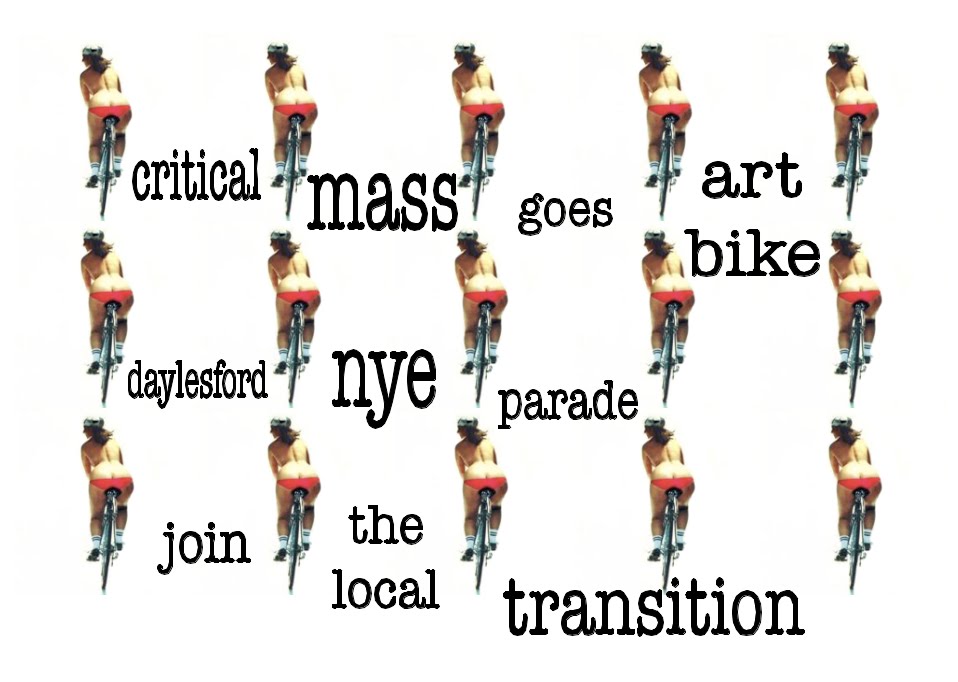
Permablitzing on pushies: critical mass goes Daylesford NYE parade

Monday, January 3, 2011

Fifty cyclists turned up for critical mass this month, which landed on NYE, so we joined the annual parade, as we're want to do. Here we are getting ready on the back streets...

Oliver Holmgren is Obtainium Engineering.

St Mel and Leah Rogers as superheroes.

Pia, Brett and Fyfe beside my new bike.

Peak oil Zephyr and mates.

David Holmgren, Su Dennet and wwoofer Gabe as medieval cycle gang.

Nicholas Hansen and Ivan Carter (behind mask).

And then when we were ready, Meg and Zero lead the ride down the main drag.

Thanks Ian for your help with the Artist as Family signs, and thanks Glen for the great pics.

Read more...

Carless in the country

Saturday, December 25, 2010

Three years ago we gave up supermarket food. Two years ago we took down the kitchen clock. A year ago we gave up air travel. And, this week we sold our car.

We have spent money on cleaning it and having it “worthy” of the road. We’re a little tense as it’s raining and one of us, eight years old, is not so aware or interested in the effects of the mud on his shoes on the upholstery. We still have some petrol in the tank. It will be enough for the journey. It’s been a year since we made the decision and we have rehearsed being carless all through the winter recording each kilometre travelled, each litre expended, and the extent to which our participation in global resource wars disables our reembodiment, our relocalisation, our humanity. And now, we’re at this point, at this significant milestone of our transition, ready to drive for the last time from the town with very little public transport to the city dripping in it, where the young guy who works for the Armed Services Credit Union, will unironically hand us a cheque which we will in turn cash in at the bicycle store. (from a letter to a Hamish Morgan, Dec 2010)

We kept a logbook for this past year for no other reason but to enable a more conscious examination of our largest polluting activity.


The financial savings living without a car will be about $10,000 pa, including initial cost of the vehicle, depreciation, petrol and maintenance. But the ecological and social savings for living the rest of our lives without one will be immeasurable. The carport will become a bikeport, garden tool shed and potting area. The driveway will be ripped up, heavily manured and become an extension of our food forest.


Yesterday we headed to Melbourne on foot, bus and train to collect our new long-tail cargo bikes. We had our helmets with us so we thought we'd give the Bike Share a go en route to the bike shop.


On the way we checked out some spontaneous urban natural history.


Then the exciting moment... Our new bikes and a tourist-like snap in the city by a passer-by.


After a quick lunch we hopped back on the train.


And rode 30km from Ballan to Daylesford. We sang and screamed for joy at the immense sense of freedom. Cars and trucks belted past, some only a foot or two away from collecting us.


We both have front baskets to take Zero, the family's Jack Russell, and Zephyr, our awesome eight year old, has new panniers and a pack rack on his ten speed racer. Stay tuned, probably on the Artist as Family blog, for bike camping/touring adventures and, more generally, a family's everyday refusal to participate in the chronic abusiveness of the dominant culture and its industrial military complex.

Read more...

Critical-creative

Tuesday, December 21, 2010


For more info try here.

Read more...

Eucalyptus (Percy) Cum - white flowering gum

Tuesday, December 14, 2010

Spermapoesis

Man arrested after ejaculating during TSA pat-down

A 47 year old gay man was arrested at San Francisco International Airport after ejaculating while being patted down by a male TSA agent. Percy Cummings, an interior designer from San Francisco, is being held without bail after the alleged incident, charged with sexually assaulting a Federal agent.

According to Cummings’ partner, Sergio Armani, Cummings has “multiple piercings on his manhood” which were detected during a full body scan. As a result, Cummings was pulled aside for a pat-down. Armani stated that the unidentified TSA agent spent “an inordinate amount of time groping” Cummings, who had apparently become sexually aroused. Cummings, who has a history of sexual dysfunction, ejaculated while the TSA agent’s hand was feeling the piercings. The TSA agent, according to several witnesses, promptly called for back up. Cummings was thrown to the ground and handcuffed.

A TSA spokesperson declined to comment on this specific case, but said that anyone ejaculating during a pat-down would be subject to arrest.
from here.

Read more...

Eucalyptus (Gary) Snyder

Monday, December 13, 2010

"Dreaming" or "dreamtime" refers to a time of fluidity, shapeshifting, interspecies conversation and intersexuality, radically creative moves, whole landscapes being altered. It is often taken to be a "mythical past," but it is not really in any time. We might as well say it is right now. It is the mode of the eternal moment of creating, of being, as contrasted with the mode of cause and effect in time. Time is the realm where people mainly live and within which history, evolution, and progress are imagined to take place. p84
Gary Snyder, The Practice of the Wild, 1981

Read more...

Eucalyptus (Oprah) Winfrey

Friday, December 10, 2010


I made this prohibition-sign-cum-visual-poem in 2004. With talk around here of Oprah visiting our pretentious little town in the next few days, this work, if I can be so conceited, borders on prophecy. The tourist operators, the baby boomers who still feel the need to cash up and burn as much resources as they damn well can, are wetting themselves at her possible arrival, their good selfless work in the community emulsifies into profits from unsustainable tourism: increased wealth = increased travel = increased pollution. Oprah brings 300 idiots from America and not one mention of this cost to the planet. Go figure.

Read more...

Peak Shell (a poem on the slide)

Wednesday, December 8, 2010

Let's make what

>we've<

got [left]

go further.

Let's go!

to the

other side

of

Hubbert's

Peak.

Read more...

America – great poets, lousy politicians

Tuesday, December 7, 2010

Earlier this year Hillary Clinton wrote:
On their own, new technologies do not take sides in the struggle for freedom and progress. But the United States does. We stand for a single internet where all of humanity has equal access to knowledge and ideas. And we recognise that the world's information infrastructure will become what we and others make of it.

This challenge may be new, but our responsibility to help ensure the free exchange of ideas goes back to the birth of our republic. The words of the first amendment to the constitution [guaranteeing freedom of speech] are carved in 50 tons of Tennessee marble on the front of this building. And every generation of Americans has worked to protect the values etched in that stone.
More here.

Read more...

Leaves and limbs

Monday, December 6, 2010

...and your very flesh shall be a great poem and have the richest fluency not only in its words but in the silent lines of its lips and face and between the lashes of your eyes and in every motion and joint of your body.
Walt Whitman, Leaves of Grass, 1855

Read more...

The question is carried

Saturday, December 4, 2010

Is the metabolic potential for a biophysical poetry – a poetry of the body and its environment (in an era of unfolding climate chaos and fossil energy descent) – an essential transition from catabolic literatures, which feed upon each other and perpetuate the systems of art that mediate our logic and make us increasingly separate from the experience of everyday life?

Read more...

Applying Fukuoka to Poetry

Friday, December 3, 2010

Can we apply Masanobu Fukuoka's 'Four Principals of Natural Farming' to poetry? The principals are: 1. No cultivation. 2. No chemical fertiliser or prepared compost. 3. No weeding by tillage or herbicides. 4. No dependence on chemicals. Here goes:

1. No cultivation – no paper; no page*.


2. No chemical fertiliser or prepared compost – no vowels.


3. No weeding by tillage or herbicides – no consonants.


4. No dependence on chemicals – no alphabets.


*Nevertheless, the perennial problem of representation remains.


Site-specific question: Is the metabolic potential for a biophysical poetry – a poetry of the body and its environment (in an era of unfolding climate chaos and fossil energy descent) – an essential transition from catabolic literatures, which feed upon each other and perpetuate the systems of art that mediate our logic and make us increasingly separate from the experience of everyday life?

Photos: Meg Ulman

Read more...

A first solar poem? geopoets, geopolitics and the first world oil war

Thursday, December 2, 2010

In his comic masterpiece, The History of Oil, Robert Newman insightfully states that Siegfried Sassoon and Wilfred Owen wouldn't be known today if they were sent to Iraq instead of France almost a century ago. Looking deeper at this claim it seems conspiratorial that mainstream historians have not focussed on oil as the main trigger for the outbreak of war. In his book Oil and the origins of the ‘War to make the world safe for Democracy’ (2007), F. William Engdahl writes of the origins of the First World War in geopolitical terms:

Beginning the 1880’s a group of leading German industrialists and bankers around Deutsche Bank’s Georg von Siemens, recognized the urgent need for some form of colonial sources of raw materials as well as industrial export outlet. With Africa and Asia long since claimed by the other Great Powers, above all Great Britain, German policy set out to develop a special economic sphere in the imperial provinces of the debt-ridden Ottoman Empire. The policy was termed “penetration pacifique” an economic dependency which would be sealed with German military advisors and equipment. Initially, the policy was not greeted with joy in Paris, St. Petersburg or London, but it was tolerated. Deutsche Bank even sought, unsuccessfully, to enlist City of London financial backing for the keystone of the Ottoman expansion policy – the Berlin-to-Baghdad railway project, a project of enormous scale and complexity that would link the interior of Anatolia and Mesopotamia (today Iraq) to Germany. What Berlin and Deutsche Bank did not say was that they had secured subsurface mineral rights, including for oil along the path of the railway, and that their geologists had discovered petroleum in Mosul, Kirkuk and Basra. Read on here.
Britain, with its coal-to-oil-transitioning navy (under Churchill), couldn't accept these strategies in the race for greater industrial power, and so youthful bodies soon started piling up on the Great Dead Heap 1914-18, including the following unmarked body that Owen memorialises in his poem Futility.
Move him into the sun -
Gently its touch awoke him once,
At home, whispering of fields unsown.
Always it woke him, even in France,
Until this morning and this snow.
If anything might rouse him now
The kind old sun will know.

Think how it wakes the seeds, -
Woke, once, the clays of a cold star.
Are limbs, so dear-achieved, are sides,
Full-nerved, - still warm, - too hard to stir?
Was it for this the clay grew tall?
- O what made fatuous sunbeams toil
To break earth's sleep at all?
The last two lines almost speak in geopolitical terms; of mining the earth. Solar energy frames this poem – the potentiality of the sun over the futility of war; fossil energy – ancient sunlight – used by industrialists for a century of war (from Owen to now) against the world.

Read more...

On being offered a biscuit

Wednesday, December 1, 2010

i read the packet’s contents
(over twenty ingredients listed)
and wonder how food
made for supermarkets
remains so cheap
and how this super obfuscation
by those who disregard
the limits to growth
made clear and manifest
from the first unnoticed spore
push on with unbound insistence

Read more...

Greenwash #18 in Trouble - composted & upcycled (part 2)

According to David Holmgren, co-originator of modern permaculture, history has revelled in humanism while remaining largely ignorant of energetic and ecological factors. For well adjusted progressive types, by which I mean schooled believers in human progress, this anthropocentric worldview is easily developed through the arts. But to those sensitive to the plight of nonhumans, ecologies and the world’s poor at the hands of progress, art can be seen as just another instrument of civilised brutality and species intransigence. Welcome to part 2 of Greenwash’s ‘composted and upcycled’. (see part 1)
Click on image to read on.

Read more...

Possibly the world's smallest critical mass

Saturday, November 27, 2010


Music by Daylesford songster, Archer.

Read more...

Found glib poem (slow text version)

Friday, November 19, 2010

Read more...

Found glib poem

Progress is
Everyone's business

Rollover to learn more
Advertisement found at theatlantic.com, as of this day.


Read more...

The poet's footprint is the poem

Thursday, November 11, 2010

I've been following Adam Roberts' engaging five part series on the state of contemporary poetry, published in The Atlantic. I'm honoured to be included in his fourth post in the series, which looks at ecological and slow poetries.

With Slow Poetry in mind, it might be necessary to say that it's not enough, anymore, for a poem to be "about nature" for it to be properly ecological... Jonathan Skinner's journal ecopoetics and Brenda Ijima's anthology eco language reader are two resources that do wonders towards helping move this discussion along. The basic argument goes something like this: the "nature poem" of old – insofar as it holds the "natural" and "human" apart as separate categories, repressing social and political context – risks reducing nature to a kind of territory for human epiphany, engaging in a kind ecological orientalism. Says Skinner: "Juliana Spahr, a poet in the Bay Area, put it brilliantly...the nature poet focuses on the bird and the bird's nest, but doesn't turn around to confront the bulldozer ... Ecopoetry expands the frame to include the bulldozer."
In this article Roberts hints at something very important and rarely discussed in ecological poetries – the relocalisation of poetry itself; the poem has to be walking distance, to expand Cuban permaculturalist Roberto Perez's maxim – 'the food has to be walking distance'. How this changes the poem is the context for my doctorate.

We went foraging for yam daisies a few days ago. Yams were once an important staple of the Djadja Wurrung, our local Yes people. Including yam daisies and other bush foods (lomandras, bracken fern, pigface and warrigal greens) into our within-walking-distance-diet calibrates us to Djadja Wurrung thinking – ecologically embodied resource-gathering, hunting and nomadic farming. Through foraging we become aware of the ecological intelligence that has been lost since invasion, and we become deeply sensitive to nuance, complexity and intensity within reciprocal-competitive natural systems. After returning from our yam forage I wrote this poem, Moonar (yam daisy), as a slow text mesostic to celebrate our increasingly relocalised existence and our deep respect for the traditional peoples of our local landbase.
Click for bigger.

For me, the important thing with a slow-text is the physical impact the poem has on the body. A coke 'n chips attention span just isn't going to cut it (either in terms of reading poems or having a future). A slow text forces a slow reading, at least for the first read; the eye stumbles over rocky ground, no neat flat monological lawns for it to glide over like ad copy; or to use 60s language – no rows of words lining up like colonising soldiers across the page.

Read more...

Newspaper by Ourblogtemplates.com 2008

Back to TOP