





A permaculture poetics
Wednesday, January 13, 2016
Spiral Orb: an experiment in permaculture poetics, is an online poetry journal based in the US. According to its editor Eric Magrane:
Spiral Orb is an experiment in juxtaposition, interrelationships, and intertextuality — a cross-pollination.
My poem Permamesostic, appeared in the first issue in 2010, and now my Anthem; elegy appears in the eleventh.

Read more...

What is industry-science?
Monday, July 27, 2015
Pretty much the only science there is today is conducted by the imperatives of industry — money. Can this model of capital-led research produce 'objective science'? What is objectivity? A wishful desire to be more-than-human? Industry-science is one of the great unexamined and unquestioned phenomenas of our age. Apparently some questions can be disappeared when polymer bank notes are on offer.

Insect repellents? Unfollow
Read more...
Primitive promotions
Saturday, July 11, 2015
After four years writing my doctorate Walking for food: Regaining permapoesis, and two more years researching and writing The art of free travel: A frugal family adventure (forthcoming UNSW Press), I'm musing about what next to focus my attention on. Here are some sketches:

This subject comes from an interest in critiquing popularist activism that avoids larger questions about civil-settler culture and the role of agriculture in making cities, and how cities originally divided labour producing not just pollution but historians, artists and like-specialists who, in turn, helped construct total ecological abstractionism.

Examining all that is under lock-and-key and why home, food and mobility are reliant on debt, and how debt ecologically, politically and ethically bankrupts through the marriage of industry-science and growth-economics.

The subject focuses on a pet hate: If you act or think differently you're an ideologue, while if you passively go along with consumer-pollution ideology, you're not. Unpopular Acts examines how our corporate-science society is the most boring ever to exist, and investigates that very brutal word 'normal' and how school shapes us for being normal corporatised citizens absent of ecstasy and looseness.Read more...
Walked-for 'free tucker' and walking 'knowledge is free'
Thursday, June 4, 2015
I wrote my doctorate paid for by public money, so (in memory of Aaron Swartz and in the spirit of Creative Commons), I make it available here free, to the public. I encourage all other scholars to do the same with their research, regardless of what copyright laws unethically demand otherwise. #knowledgeisfree.
Everything you've learnt is just provisional; it's always open to recantation or refutation or questioning. The same applies to society. — Aaron SwartzRead more...
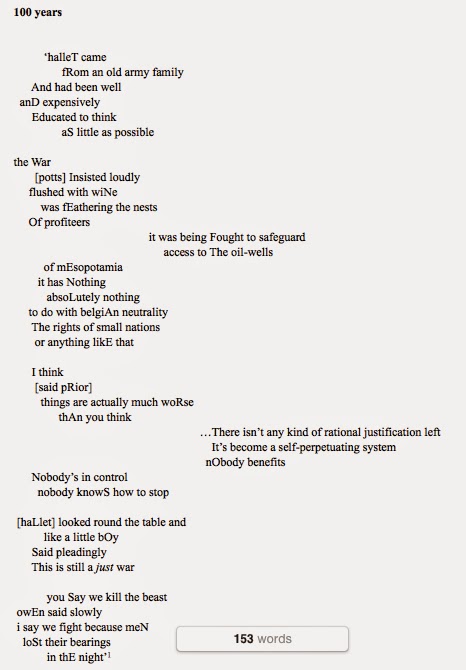
A happy fuckin’ ANZAC Day centenary sampling to accompany a portrait of the British flag tabloid raised at night (Jerry Seinfeld) in the southern hemisphere chapter of the global monetary economy oil wars (in 153 words)
Friday, April 24, 2015

A short string of drawings from the road (in celebration of being on our bicycles for a year)
Sunday, November 16, 2014
 |
| Letter to elders |
 |
| Keeping chickens |
 |
| New flag |
 |
| Obedience |
 |
| Queensland |
What are the foundations on which this country is built?
Friday, July 18, 2014
Damaging technics, greed and narrow self-interest, inducing policies of abuse and genocide that are still in effect?
 |
| Click for bigger |
Read more...

Dwell, at Plumwood Mountain
Thursday, February 6, 2014
We publish poetry that may broadly be understood as engaging with a more-than-human context, in a variety of poetic forms, articles on the poetics and intent of ecopoetry, exploring ways in which poetry not only responds to and affects its world, but also ways in which poetic practice can model ecological systems and concerns, the ways in which poems themselves are material, breathy things in a world of animate matter, and reviews of collections of poetry that understand themselves or could be understood as ecopoetry.Plumwood Mountain is part of a cultural reshaping toward what Val Plumwood called an ‘environmental culture’.
My slow-text mesostic, Dwell, was published in this first issue.

Read the previous post regarding my current collaborative performance project.
Over there
Wednesday, November 27, 2013
Hi there, if you hadn't already got the news I'm hanging around over at the Artist as Family blog for the next year while we conduct research for a new book called Free Food. In this book we aim to put together all of our experiments in foraging, hunting, gifting and swapping, low-carbon travelling, poaching, free-loading and generally living a very small ecological footprint in this very big country.

Read more...
Contour ploughing (poetry, permaculture and P A Yeomans)
Monday, November 11, 2013
Packing up the house today. About to leave on a year's adventure. Dipping into old notebooks. Stopping on this page. From fifteen years ago. A hill in Musk, close to here: Contour ploughing.

A black shouldered kite
follows my spine –
scribed by a grader,
filled with coarse rock
pursues the depression
contours of my
tired back;
my blades
with sour grasses
of mid-summer
once covered in clover
like my belly now
dark and wet
protected from the sun's west
The drawing and poem were very simply imagined sometime in my late twenties (the notebook entry is undated). A vineyard is now situated on this hill, but it has never been ploughed on contour to create swales for passive water harvesting.
Well before I was ready to know about P A Yeomans, permaculture, ploughs and poetics or my own political imperative of bringing back the digging stick, I was intuitively writing and drawing up the logic of rehydrating land through swales – spoon drains that follow contours and hold up rain water. All these years later Ian Milliss and Lucas Ihlein are focussing on these very relationships in a show called The Yeomans Project. They have asked Milkwood Permaculture, Taranaki Farm, (f)route, Diego Bonetto and us, Artist as Family, along for the ride. And we will be riding over 1000 kms to witness this project, leaving Friday. Read more...
Buckley and me
During my doctoral research I got to know William Buckley pretty well. As I was scouring material on him a friend, Maya Ward, recommended I read Strandloper, which is an excellent novel based on his life. I have called Buckley the first Australian permaculturalist (cheekily, in front of David Holmgren). Last year Southerly published my Portrait of the escaped convict who slowly nativised into a Wathaurong man over 32 years before Batman and co discovered him. The poem features in my thesis alongside this photograph painted by an unknown artist and undated. The painting hangs in the State Library of Victoria.

Today I was rifling through some images and I came across this photograph taken of me reading at the Victorian Writers' Centre (next door to the SLV) in 2011. I'm standing in front of my poem Step by step, which also features in my thesis.

An uncanny resemblance between permaculture poets? Buckley is important to me because he is a rare European who listened to and learnt from Indigenous land spirit and intelligence. Read more...
Jaara Jaara Seasons
Sunday, November 3, 2013
There has been a resurgence of thought about Aboriginal seasonality in these parts. My friend Tanya Loos recently launched in Daylesford her book Six Seasons in the Foothill Forests, which includes a dust jacket that folds out into this very special calendar:

In surmising the six seasons of the Daylesford region Tanya's sources were many and varied, including references from Jaara elder Uncle Brien Nelson. Her book will be launched at Readings Carlton this Wednesday 6 November at 6.30pm. Congratulations Tanya!
Then today, some friends and I went to hear Ros Bandt's Jaara Jaara Seasons, a Bush Sound Performance that took place in the Acoustic Sanctuary in nearby Fryerstown. A few hundred people came to listen.

I first met Ros a little while back at Jude Perry and Uncle Brien's Bunjil Park where we both took a traditional basket weaving workshop. Today Uncle Brien's son Rick Nelson sang Welcome to Country accompanied by Ron Murray on didgeridoo.

Their short but powerful welcome led us into a diverse environment with diverse weather, bordering on six seasons in one afternoon.

Through multiple instruments and from several amplification points, sound, song and spoken work emerged. People moved through Jaara country, the work physically formed in us. Local birds and falling rain intervened knowingly.

As did a myriad of wild flowers, these particular lilies refusing to be captured as they danced in the wind.

The sound in the bush was restorative and nurturing. It enabled reflection and understanding. It didn't shy away from or disappear colonisation,

but more so provided a place for maturity. After the performance one friend commented that she wanted to get out of doors more often and listen more intently. I agreed and replied how I'm looking forward to living outside for at least the next year.

Congratulations Ros and her fellow performers: Rick Nelson, Ron Murray, Sarah James, Mary Doumany, Le Tuan Hung and Wang Zheng Ting. Read more...
Wanted urgently!
Sunday, October 27, 2013
Publishers who understand ecological crises, monetary damage, and the imperatives of radical change. Publishers open to new models for human societies, who understand multiform and experimental texts, who get biodiversity and the relationships between food, energy and ecology. Publishers who are giving up on perpetuating anthropocentric pollution ideology and who promote the composting of hierarchical and unjust social orders. Publishers who value the reclaiming of low-carbon, regenerative technologies, thought and deeds and believe they can contribute to a future of aggregating uncertainty and struggle but nonetheless joy, resilience and intelligence.
If you know of any publisher that fits such a description please let me know.
Gariwerd boomerang
Tuesday, October 22, 2013
For a while now I've wanted to make a boomerang. A recent trip to Gariwerd became the perfect time to do it. I took a few basic tools with me and late one afternoon I set out from our camp to find an appropriate wattle limb.

Near to where Zeph, Gabe and I were camping I found a lightwood wattle (Acacia implexa) that had blown over in a storm. It was still quite green and I found a suitable part to cut out.

I then got to work with my small hatchet cutting a basic form,

before beginning work on shaving down the sides. Traditionally, a stone head axe of a similar size would have been used to shape such tools.

I then used the small saw to do some more basic shaping,

returning to more shaving until most of the wood was removed. A boomerang is the precursor to an airplane's wing and precedes this technology by about forty thousand years. It has a flat under side and a curved up side.

I then used my pocket knife to finely finish the boomerang. It flew well, but didn't return. Someone at the camp joked, if it doesn't return it is not a boomerang, it's just a stick. I needed some better advice than this so we headed off to the Brambuk Cultural Centre again.

We admired the traditional boomerangs in the Brambuk collection,

and booked in to the boomerang throwing workshop with Jeremy. He kindly gave some great tips on getting my next boomerang to return. He suggested that the shape of mine was generally used for ceremonies. Next time I will try to find an acacia root with a greater natural curve.
On no other continent did people develop a returning arrow. This ingenious tool really indicates an incredible intelligence. I have often heard it said that Aboriginal people purposely didn't develop their technology beyond their edible and ceremonial needs. This represents a mature sensibility to land and resources that the west (and its anxiety for innovation) could really refer to now. Read more...
Gariwerd bush foods
Monday, October 21, 2013
Zeph and I joined the Victorian home educators camp at Halls Gap in the Grampians this week. We came with a community friend Gabe and the two boys joined over 100 kids from all over the state (and further afield). For five days we experienced unpredictable weather, night games, wrestling, abseiling, rock climbing, new friend making, swimming, tiredness, ball games, bike-riding, sunburn, boomerang throwing, cuts and bruises and some autonomous food.
 |
| Blow fly grass (Briza maxima) also known as quaking grass |
 |
| Three-cornered garlic (Allium triquetrum) |
 |
| Milkmaids (Burchardia umbellate) |
 |
| Deer (Cervidae family) and Kangaroo (Macropod, meaning 'large foot') |
 |
| Round-leaf Mint (Prostanthera rotundifolia), Strawberry Gum (Eucalyptus olida), Wattleseed (Acacia sp) Lemon myrtle (Backhousia citriodora) |
 |
| Mat-rush (Lomandra longifolia) a common source of starchy food |
 |
| Honey myrtle (Melaleuca sp.) |
 |
| Grass tree (Xanthorrhoea sp.) |
 |
| Phlebopus marginatus |
All Rights Relinquished
Tuesday, October 8, 2013
There is a colourful stoush going on at Overland about:
PLAGIARISM:–
More virulent than MODERNISM
More critical than POST–MODERNISM
Read the full story inside!
 |
| Home, Stewart. Plagiarism: Art as Commodity and Strategies for its Negation, London: Aporia Press, 1988. |
 |
| Tipping, Richard & Mansell, Chris. Lessons for Plagairists (with a Special Proem by Bill Posters, Complete with Precepts and a Handy Compendium of Instructions), Sydney: Well Sprung Productions, 2013. |
And more grist for the mill at Notes from the Sinister Quarter. Read more...
Subscribe to:
Posts (Atom)