








Meeting Vandana Shiva
Wednesday, July 18, 2012
I walked along Diamond Creek from Eltham Station on my way to Montsalvat late yesterday afternoon to listen to Vandana Shiva. Gertrude Stein wrote 'People are the way their land and air are'; this is the current state of the sediment infested Diamond Creek, which feeds into the Yarra River.

I found evidence of both human and more-than-human restoration of the stream-side ecology. However most of the naturalising floras along the creek have no ecological status – chickweed, spear thistle, dock, dandelion, stinging nettle, oxalis and blackberry to name a few. These are all edible-medicinal plants (oxalis in small doses) that fix nitrogen and carbon, build soil structure and mycorrhizal relations, provide habitat and food for all forms of creatures and help reduce soil erosion and thus sediment flows into the river – sediments that could potentially kill aquatic life. The areas of restoration carried out by humans, which have ecological status, is especially marked by pollutants (plastic bags) and soil disturbance created by heavy machinery and the spraying of glysophate poisons. Where there might eventually be some ecological value in this sort of anthropocentric reconstruction of the biosphere (if left to its own devices) the ecological benefits being carried out autonomously by the more-than-human seem far more significant, generating no pollution and requiring no money. This photo shows an example of the two zones – the autonomous and the anthropocentric split down the middle.

Earlier I had walked past the local primary school and noted two large banners on the front fence advertising both Coles and Woolworths supermarkets. These two con campaigns from Australia's industrial food duopoly were something to do with raising money for school sports equipment. After I left Diamond Creek I waited a long time for a break in the traffic to cross Main Road and walked on towards Montsalvat recalling Vandana's brilliant critique of car ideology in Soil Not Oil. Not far from where I was to hear her speak I came across a disturbing sign, which was more evidence of so-called 'green' initiatives really being an act of warfare against the planet. To use money (to be in debt) to buy poisons to kill what freely and lovingly avails itself to us is the very definition of insanity.

I arrived early at Montsalvat and sat in the barn where the event was to take place. Vandana Shiva also arrived early and I introduced myself. She is a remarkable being, fiercely intelligent, a stern defender of the grandmotherly earth. I took around 20 minutes of footage of Vandana speaking before my camera's memory ran out. I then relied on my own, transferring technics for my mind's ecological carrying capacity. I'll upload a short video of excerpts from Vandana's talk shortly.

Afterwards there was time for a few questions. Mine went something like this:
One environmentalist [Jensen (2006:547)] believes that the only level of technology truly sustainable was developed in the Stone-Age, a million years ago. We know industrial technology is inherently abusive and damaging but what level of technology, between a million years ago and say 300 years ago, do you think should we be employing?
To which she immediately dressed down my question, attacking the very notion of 'levels', calling them Cartesian, abstract, mechanistic. Jensen has written extensively on the ills of Descartes and favouring abstract and mechanistic thinking, but it's obviously still so entrenched. Vandana's attack on my language is indeed a gift. "Yes," I was thinking as she spoke, "yes levels are these things, and more than this they are also affluence speaking." She went on (and I'm paraphrasing her here): "Collapse is already occurring, people will use what tools they have available to make a life." And of course this is the same argument permaculturalists follow; that biological activity and technical complexity is enabled by what energy is available.
Read more...
Wombat Forest and its waters under threat of gold mining contamination
Monday, July 16, 2012
Let's not beat about the bush, gold mining is an activity of industrial pollution.
Fight for what brings love and against that which causes damage!
Ecological carrying capacity (or, it's all about storage and limits)
Saturday, July 7, 2012
Working on some energy descent era technics today building a crate to go on a bike trailer that fellow bike nut Andy (Mechanarchy) did up for us.

When we gave the trailer to Andy it was a write-off. It is now a fully functional trailer that apparently dates back to the 1920s. Thanks Andy!

The crate will have a base and some internal boarding, however I want to keep it as light as possible. We will collect animal manures, firewood and compost material in it, and eventually...

a little one of us, for this is our family wagon as well. Meg is now thirty-three weeks up the duff and we're looking forward to a home-birth.

Earlier today we strapped our shoe basket onto the trailer and headed to the town hall where Meg conducted a free sauerkraut workshop with around twenty participants. Our cellar (another post-pollution technic) is loaded with breast-feeding stout, garlic, potatoes, artichokes, jams, chutney and wild ferments.
Carbon pollution is as much to do with our food supply system as it is our modes of transport, that's why both need attending to in equal weight.
Read more...
Flesh of the forest floor
Monday, June 25, 2012
I took a short break from my writing today and wandered up to visit Zeph at his new cubby in the bush.

On the way there I collected some wood blewits (Clitocybe nuda) as a cubby-warming gift.

We cooked them on a small fire that Zeph had managed to start despite the soaked winter wood.

And made sure we cooked them well through as blewits contain a toxin that can be harmful if not well cooked.

I asked Zeph whether mushrooms shared closer DNA to animals than plants. He answered correctly.
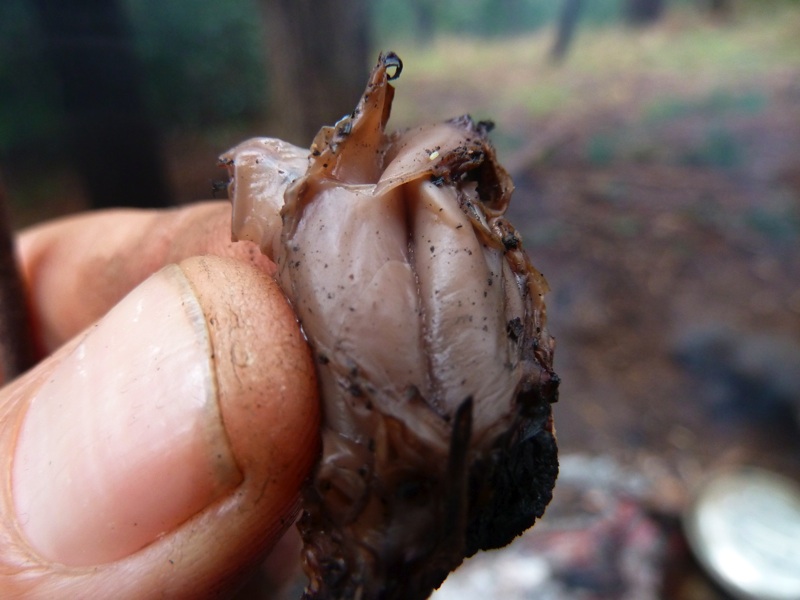
Wood blewits are sweat meats to taste and before they're cooked smell of chocolate earth. Read more...
Permeate (on Radio National)
Tuesday, June 19, 2012

The first installment of the Permeate series.
Throughout the year, Miyuki Jokiranta will bring us the stories of artists who draw inspiration from the environment. This week we hear from musician and improviser Jim Denley, who has recorded extensively in the Australian outdoors.In the weeks to come Permapoesis will be featured in this series. I'll keep you posted. Read more...
For the record
Friday, June 8, 2012
I gave a presentation on ecological and community food systems at RMIT a little while ago, invited by Juliette Anich who takes a pretty interesting class on urban food generation. Juliette's students have been developing a research project called The Inevedible Garden, and invited me back to talk as part of a short video work.
On The Inevedible Garden homepage these tenacious students get straight to the point:
"The inevitable advent of urban food gardens, to undermine the current unethical food production methods."It is so great to see such courage and astuteness from students when big business (Coles and Woolworths and so-called public organisations such as CropLife Australia) is advocating so aggressively for ongoing chemicalised-industrial food production (check out CropLife's greenwash on their website).
We all have a role to play to bring on the local, mycorrhizal, ethical and ecological food revolution! And we all have a role to play to bring down the greedy, chemicalised, cancer-producing, environment destroying agricultures that are fueling climate change. Every dollar you keep out of the supermarkets is a small win for your health and the health of the planet. Don't be fooled by organic food in supermarkets – the ecological footprint of any supermarket food is far too much for the world to sustain. It only takes around 15-20% of market collapse to bring down a giant company, so get involved in your local community, backyard or balcony garden, start one up, find out more about the soil and its billions of workers, grow food anywhere you can, and share it and your experiences with others. These things will bring about significant change and raise your awareness of how our food and our ecologies are linked, things that all other earthly beings know inherently and we have temporarily forgotten. Take back our food systems, where possible make food a non-monetary resource, reduce our enslavement in the monetary economy that serves big business, and reclaim ecological functioning as creatures of the understory! Read more...
A forest camp
Tuesday, May 29, 2012
Two friends of mine and I have been working on establishing an ecological business, A Forest Camp, for adults, family groups, businesses and organisations.
Campers will be asked to come by public transport to Daylesford and walk into the bush with their forest guides (that's us!). Over a weekend (or longer, depending on the group) they will eat a non-packaged, locavore vegetarian diet of locally sourced organic food (and some foraged foods, depending on the season). Campers have the option of building their own shelter or sleeping in a tent. They will be able to learn how to make fire and many other bush skills, if they desire. But mostly this camp is to provide the space for people to be students of a forest and rejuvenate their senses.
 |
The image above shows my fingers about to pick and eat an unripe native cherry (Exocarpos cupressiformis). Still edible when yellow, though when they turn red they're delicious.
Please check out the site and spread the word.
|
A small video-poem concerning agriculture and well-being
Sunday, May 27, 2012
I wrote this poem and took the footage roughly a year ago when in Mole Creek (Tasmania) visiting family. I finished editing it yesterday. Enjoy!
A ten minute crash course in edible fungi
Friday, May 25, 2012
Two new friends that I met through the community gardens, Dave and Doug (and Doug's lovely son Malachi), came out foraging with me yesterday in pine forest plantations on the edge of town. I asked Dave if he would film our little excursion so we could make a beginner's guide to foraging edible mushrooms.
Identification is critical before consuming 'shrooms. Books and static images are not often enough to identify accurately. I hope this little video document provides enough tips to get you started. And remember, if you're not 100% sure, trust your instincts and do not eat it.
For much of my fungal knowledge attained thus far I owe to my friend Alison Pouliot, who runs courses in south-eastern Australia in autumn every year. Thanks Alison!

Hit and miss (in the gift economy)
Friday, May 4, 2012
I walked for two hours today with my mushroom brush, Zero (Jack Russell) and an empty basket, hiking through various types of forest from eucalypt to pine and mixed species that surround the town. Foraging is so hit and miss, which is what I love about it. I like that nothing is guaranteed and that it's based on chance and perception. I was ready to head home when I decided to push on down a little creek-hugging track where I scored some rather aging but still edible saffron milk caps (Lactarius deliciosus) and wood blewits (Lepista nuda).
Then coming through the bush on the edge of town I spotted a laden fig tree (black genoa, I think), and asked my near neighbour if I could take some. He obliged and I happily returned home with a basket half brimming with uncapitalised goodness. I'll drop some 'shrooms off to him shortly, on a day I get a bigger haul.

As the mushrooms were quite wet from last night's rain I dried them out in a low oven before I added them to a garden soup of leeks, potatoes, mustard greens, parsley, warrigal greens, spring onions and chickweed. The figs are a surprise gift for my beautiful and pregnant Meg. Happy days!

Walking for Food
Monday, April 30, 2012
I've been in Hobart for twelve days staying with my friend Glen, attempting to put together a first draft of all the chapters I've been working on over the past thirty months that constitute my doctoral research work, 'Walking for Food' (working title).

While at Glen's I was able to forage in his local neighbourhood. I brought to our table rosemary, figs, mallow, dandelion, hawksbeard, apples, feijoas, fennel, borage flowers, stickyweed, rosehips, crab apples, and up on Mount Nelson high above the suburbs I came across the one fungus I saw in hobart, the curry punk (Piptoporus australiensis), which I consumed only as sensory delight. Walking and foraging helped me loosen up my sedentary studious body, but I also resorted to quick break outs in Glen's apartment overlooking the Derwent River.
Arriving back in Melbourne yesterday morning I wandered once more disappointingly into The Age while I waited for a cup of tea and read another stupid article on foraging. Will the bourgeoise please take a plate of death caps now. Actually the article was not really on foraging at all but on secreting, privatising and selfishly capitalising on the autonomous food commons. Arseholes!
 |
| Photo: Meredith O'Shea |

At the dinner I was on the affirmative team with Tasmanian food writer Graeme Phillips and my friend Alison, a photographer and fungi educator who I've been doing an informal apprenticeship with while helping her out with the brilliant workshops she runs. We argued for a return to commonsense and self-accountability, not the continuation of the nanny state. Naturally I found this debate a platform to critique anti-ecological society, its estrangement due to a lost connection with food. We won!
Then after the dinner I hooked up with Glen for a final bash at Hobart nightlife, and headed to the Brisbane Hotel to see the FUN FUN FUN world of the 5678s. They were very cheap, cool and mingled with the common mycelium after the show. I had a chat with bassist Akiko Omo about all things punk, fungus and Hobart.


Interspecies love (kind of)
Saturday, April 14, 2012
Our band played last night and I had the pleasure of singing Blake's The Fly (1794), which I set to music a little while ago.
Bunch of Bandits, Glenlyon General Store. Thanks for filming Primo!
Progress Capitalists – What will they think of next?
Friday, April 6, 2012
|
Published on Thursday, April 5, 2012 by Common Dreams
USGS: Recent Earthquakes 'Almost Certainly Manmade'
Report implicates oil and natural gas drilling, aka fracking.
|

A US Geological Survey (USGS) research team has linked oil and natural gas drilling operations to a series of recent earthquakes from Alabama to the Northern Rockies.
According to the study led by USGS geophysicist William Ellsworth, the spike in earthquakes since 2001 near oil and gas extraction operations is “almost certainly man-made.” The research team cites underground injection of drilling wastewater as a possible cause.
“With gasoline prices at $4 a gallon, there’s pressure to rush ahead with drilling, but the USGS report is another piece of evidence that shows we have to proceed carefully,” said Dusty Horwitt, Senior Counsel and chief natural resources analyst at Environmental Working Group. “We can’t afford multi-million-dollar water pollution cleanups or earthquakes that could pose risks to homes and health.”
Read on here.
WWOOFing on country (a postcard from Summerfield)
Sunday, April 1, 2012
Jaara elder Uncle Brien Nelson and his partner Jude Perry welcomed Zeph and I into their home last week to WWOOF.
Early on the first day we walked from our home to the bus and travelled to Woodend.

We then took a Swan Hill bound train to Eaglehawk station and had some time to wait there before being picked up by Jude.

On reaching Summerfield we came across a stand of scar trees.

Jude told us Jaara people used the bark to make canoes and

coolamons (carrying vessels) without killing the trees.

We arrive at Jude and Uncle Brien's and find a garden full of Indigenous spinach.

It was hot working in the sun and by the afternoons we needed to cool off.

Uncle Brien worked with us during the day and on one afternoon came down to life guard.

Our days were spent working around chooks, horses and dogs. We built some fences and we took some down.

During the week we shared skills, knowledges, meals and plenty of jokes.

Thank you Jude and Uncle Brien for a wonderful week.
Read more...
Step by Step
Wednesday, March 21, 2012
My permaculture poem Step by Step was yesterday awarded joint runner-up in the 2011 Overland Judith Wright Poetry Prize. Today I recorded the poem with some guitar accompaniment.
Overland will publish the poem in the next issue. Here's what judge Peter Minter very generously said about the work:
I think it’s probably fair to say that reading Jones’ ‘slow-text mesostic’ poems (cf John Cage) is a bit like extruding the brain through barbed wire mesh. But, as the saying goes the grass is always greener on the other side, so it’s a worthwhile endeavour in the end. Jones makes an explicit attack upon the romantic self-consciousness of white Australian literary culture and its oblivious transportation of European aesthetic modes into antipodean landscapes. ‘Step by step’ is not about ‘emotion recollected in tranquillity’. Its typographical interferences and static slowdown, hook and strain the reading process, such that emotion, reflection and cognition are caught and inflected in the present-time of reading. Jones forces us to grapple with a specific set of poethical considerations: how does language-use contribute to the violence of colonisation and machineries and economies of ecological destruction? What kinds of vernacular interventions might inhibit such violence? Can poetry save the world? Jones’ poetry isn’t for everyone, but the world he is saving is the same one you’re living in.Congratulations Joel Ephraim who's poem Rock Candy won the prize, and Sam Langer's Clouds fall like snow on the sky’s clear rocks who shares runner up with me. Also congrats to commended poets Rebecca Kylie Law, Alana Kelsall, Ella O’Keefe, Astrid Lorange, Fiona Hile, Stephen Nichols, Andrew Slattery, Banjo James, Molly Murn and Aden Rolfe.
Read Peter's full report here. Read more...
The scorn of women
Thursday, March 1, 2012
This poem traces thoughts and feelings from the so-called 'late' birth of my son ten years ago to the expected birth of my second child this coming spring. The poem documents the political ground lost to women and families who wish to birth at home over this decade, and the increasing pressure from medicine to turn women into compliant patients and disempower them. This is a father's call to arms, to defend the rights of their partners to birth at home away from the interference and sterilised hysteria of medics.
"Doctors and medicine become necessary when people create a sickly environment." Masanobu Fukuoka, 1978 Read more...
Another clear picture to draw inspiration from...
Milkwood Permaculture co-founder, Nick Ritar, puts together a well-structured argument to help fight human complacency, idiocy and anxiety in an age of crises.

Nicole Foss on resilience and financial collapse
Friday, February 17, 2012
Hepburn Relocalisation Network and Sustainable Hepburn Association (SHARE) last night hosted Canadian speaker Nicole Foss. A theorist and practitioner, Foss is well across looming energy, economics, psychology, sustainability (the real kind – not just economic), security and climate conundrums. Here's a slide from her talk:

And here's a wee bit of footage of Foss and David Holmgren fielding questions in the town hall last night.
Read more...
Walking and weaving country
Monday, February 13, 2012
Here's a short documentation of my first day's walk through Jaara country to take a traditional Aboriginal weaving workshop and meet the founders of Bunjil Park Aboriginal Education and Cultural Centre, Jude Perry and Uncle Brien Nelson.
Here's the small basket I made at the workshop.

This is the hand-drawn map that I used on my walk.

And here's Jude and Uncle Brien extracting worm tea at Bunjil Park.

Read more...
Capitalism's Dirty Water
Tuesday, January 31, 2012
Coca Cola takes a lot from my local region. It sucks Dja Dja Wurrung groundwater from the ecosystem, trucks it to a Melbourne factory where it's rumoured it's mixed with ordinary tap water, then it is packaged in petrochemical bottles, and marked up several hundred percent to sell to idiot consumer-polluters as bottled water.
I came up with the lyrics for this song after I and my son Zephyr came across a fellow community gardener, Lena, had picked up a half-consumed bottled of coke that had been thrown into one the community gardens. She looked at Zeph's interest in the bottle and said, "don't worry, I don't drink this toxic rubbish", and borrowing a line from a friend she added: "this is capitalism's dirty water you know." Awesome stuff! Lena is a true elder...
So, introducing to permapoesis for the first time, the band I'm in, Bunch of Bandits singing Dirty Water. (All of us in the band met through our community gardens... Corporate bullies beware! Strong language alert, this one's aimed straight at your pea brains; or for those who know better, a jingle to sing to your kids at night to counter the multi-million dollar ad campaigns Coke directs at them):
This little clip was filmed by Zephyr (aged nearly 10). Nice work Zeph!
Read more...
Some Summer Reading
Your mother is pure Black
happy forever with the Water Hen
Lionel Fogarty Ruby Dilli (Eyes) Southerly (Vol 71 No 2) 2011 p124
There is a cost to non-Indigenous as well as Indigenous people when the privileges of (white) society are based upon lies about ourselves and our past.
Sarah Maddison Beyond White Guilt: The Real Challenge for Black-White Relations in Australia Allen & Unwin Australia 2011 p20
Techniques and technologies necessary to manage our lives and natural resources sustainably are known. However, simple ways of living contradict the growth of commodities and services, which drives capitalism.
Anitra Nelson and Frans Timmerman Life Without Money: Building Fair and Sustainable Economies Pluto Press London 2011 p14
Even in the full blossom of life, decay and death were just around the corner. The world was a joyous thing with maggots at the centre, Wombalano Beeaar had once told him.
Craig Robertson Buckley's Hope: The Real Life Story of Australia's Robinson Crusoe Scribe Melbourne 1980 p160
As Lewis Mumford saw it amidst the carnage of World War II, "Western civilization became mechanically unified and socially disintegrated" (Values for Survival, 190)... The supposed rationalization of technology, he found, often concealed pockets of irrationality: "immense gains in valuable knowledge and usable productivity were canceled out by equally great increases in ostentatious waste, paranoid hostility, insensate destructiveness, hideous random extermination" (Lewis Mumford Reader, 134).
Jed Rasula This Compost: Ecological Imperatives in American Poetry University of Georgia Press Athens and London 2002 p49
Say
Australia from the edges of a wound
a circus of dusty blood sucked
from a metal carcass in Minyirr's old heart
the softly burning horizon screaming
as if a mineral-old candle
had coagulated
around the wooden boats of Enlightenment and flared
up above us
the dancing phantoms of the flaming
place-time scrub.
Stuart Cooke Edge Water (excerpt from Broome Song) Interactive Press Queensland 2011 p63
Subscribe to:
Posts (Atom)
