




Energy, primitivism and slow text
Monday, May 9, 2011
Primitivism, as a purely intellectual thing, is indeed problematic terrain. However, once the primitive, by which I mean activity that transcends history (such as foraging), cohabits everyday practice, it ceases to be utopian and becomes instead pragmatic, or something not of wishfulness or fantasy. This is especially the case if we are to consider global energy powerdown, where primitive forms will again have currency due to a fall in affluence.
So often ecological thought rides exclusively between humanism and ecology and skips energy altogether. "The energetic is nearly always left out of the equation" (David Holmgren, 2010), which seems strange especially when the aestheticisation or mediatisation of nature – our very predicament, or crisis – is precisely linked to high energy inputs – our affluence. Three hundred years of high fossil fuel productions has necessitated that art leads the disembodiment or 'hyper-separation' (Val Plumwood, 2002) process as populations swell into cities and radicals, peasants and indigenous folk no longer have anywhere to practice unclocked forms.
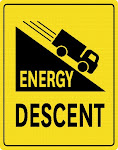
William Blake, printer and poet, with a love of being naked and in the garden, is one such marker of the end of European art as a low energy, unclocked, minimal noise activity. At the time of writing The Garden of Love (1794) coal furnaces were being build and beginning to change his beloved Albion for ever. Today, the screeching, oil dripping 'blob' of Thomas De Zengotita's Mediated (2005) culture, or the all-tech 'ambient blur' that Timothy Morton describes in Ecology without Nature (2007), are both – blob and blur – necessarily immersed in cheap crude oil, and they must necessarily find primitivist forms abhorrent or at best just another choice in a smorgasboard of options. Whereas, when you consider a powering down, even as a 'long descent' (Greer, 2010), the options to pollute, to be allopoetical, or to drive aesthetics globally, necessarily reduce. This reduction is very scary if you imagine energy powerdown (post global aggregated capitalism) as a return to agricultural toil, direct animal cruelty (as opposed to the indirect global cruelty we exhibit today; passivism is an option as long as others are doing the dirty work), and authoritarian sexual repression. But not so if one considers the possibility of an eroding private property (intellectual and physical) culture and the reestablishment of a foraging commons courtesy of collapsing globalised economies wholly reliant on cheap fossil fuels.
Rather than some vague Rousseauian pigmented or pixalated image of primitivism, which is of course just groundless fantasy, we now have real, of the soil, applied ecological breakthroughs that are current practiced modes of primitivism. These can be evidenced in Masanobu Fukuoka's 'do nothing farming', Permaculture's 'food forestry', and in a growing culture of urban foraging witnessed across the blogosphere (such as here and here).
For me, at least, primitivism is not a conjuring of the old world for old world's sake, but rather an attempt to concieve of a present and future with low energy inputs; today, for reasons to do with social and ecological justice, and tomorrow, for issues of species resilience. We are at the tailend of an era of cheap oil and many thinkers haven't factored this within their intellectual framework. It's like there's an abiding belief there will always be an abundance of energy, making what we do today always possible. Conceiving energy powerdown is to concieve of redistributed (reruralised) populations, which, among many other things, will attend to the homogenisation of global ascent capitalism – the so-called global village. Any socialism – from Marxism to Fascism – persevering with industrialisation is thinking fairly short-term, unless of course there is a conjuring of fantasy world resources on some distant planet.
I'm not advocating here a pure primitivism or necessarily a whole primitivism. It's way too simplistic to think along these lines, or perhaps just too early. However, in attending to technofetishisation and the spectacle and 'false cycles' (Guy Debord) of clock-time, I am advocating a rethinking of the primitive per-se at a time of peaking fossils, phosphates, fish, water and just about every other essential element that drives industrial culture on and on.
As a kind of 'doing-saying' (Joan Retallack) evidence of this rethinking, I repost my video-poem-recipe, A Place of Simple Feeding, after re-recording the spoken words today and adding a brief visual clip of the poem as a slow text 'mesostic' (John Cage) for the page. Or, at least a seconds worth of detail of it. The aesthetics aren't pure, instead they're mutable responses to the less than bodily in art today. The slow text (super and subscripted vowels) shows the physical relationship between letters, words, chance, foraging and berries. A move away from Cartesian letters lining up in monological rows (like this text), or ambient representations requiring large energy inputs – styrofoam art, international careerism et al.
Decapitalised art, decapitalised food.
Read more...


