Symbol-free feeding (on the coast again)

Saturday, February 2, 2013

We haven't been able to stay away from the Victorian coast this summer and so we've had to find out a little more about the edibles down there as we camped again and had at least one main meal a day of fish and greens that we foraged and hunted (with hand spear) for. We left home in Jaara country and moved around through Wathaurong and on into Bunurong country, crossing the bay at Queenscliff by ferry.

These are some of the things we found:

Tetragonia implexicoma, Bower Spinach similar to New Zealand Spinach (Tetragonia tetragonioides) by its 4 perianth segments (instead of 5), its yellow flowers and succulent fruit. Used as a leaf vegetable by Indigenous Australians and early Europeans as a source of vitamin C to ward off scurvy. The berries were used as a red dye; they are edible but not highly desirable. 
Tetragonia implexicoma (Bower Spinach)

Rhagodia candolleana, Seaberry salt-bush is a rigorous plant good for stabalising eroded sites. Birds seed this species as they like to feed on the red staining berries. Confined to the Southern coastline of Australia. The cooked leaves of young plants are delicious, the fruit is very bitter but edible, very dark red when ripe, would make a great dye.
Rhagodia candolleana (Seaberry salt-bush)


Carpobrotus glaucescens – all parts of Pigface are edible. The raw purple flowers are delicious, sweet and salty they taste like figs; fresh or dried fruit; triangular leaves cooked; high in protein. 
Carpobrotus glaucescens (Pigface)


Lycium ferocissimum the African boxthorn, according to Tim Low (1988) has orange or red berries, grows on coasts and on the plains in southern Australia, and the bitter berries are edible. We can also attest they are edible, although would be better cooked and added to honey or dried to extract the bitterness and bring out the natural sugars. They look similar to the native boxthorn (L. australe), which have smaller, fleshier leaves and are found inland in southern Australia.
Lycium ferocissimum (African boxthorn)

Meuschenia freycineti, Sixspine Leatherjacket colouration can change with growth. The species is endemic to Australia. The meat is delicious, cook with skin and peel off when ready or skin first.
Meuschenia freycineti (Sixspine Leatherjacket)

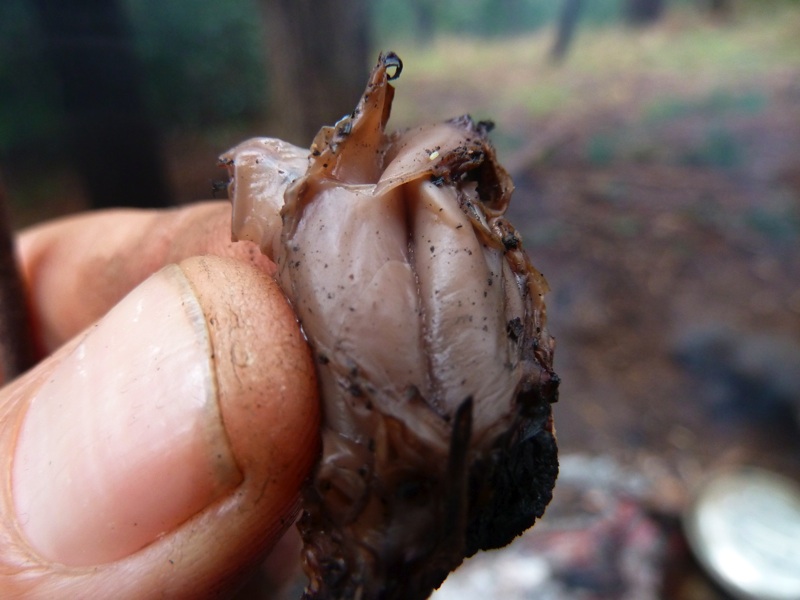
There were a number of things we tried but didn't know the names of, such as these two fish. 
Unidentified fish from Port Phillip Bay 


Alyxia buxifolia, Sea box is confined to coastal habitats along the southern coastline of Australia. Often grows in exposed situations where they are pruned by wind. The fruit is eaten by birds. We nibbled a tiny piece of berry and later found out they are supposedly toxic to humans. However, we can attest, they are not poisonous (fatal or otherwise) in a small dose. They are very astringent and not palatable at least eaten raw.
Alyxia buxifolia (Sea box)

Solanum carolinense, Tropical Soda Apple or Horse Nettle. This crazy looking thorny plant is a nightshade that hails from the USA. They start out with a mottle green fruit before turning yellow. Edibility is doubtful, we didn't try this plant and I couldn't find any information on this plant reported in Victoria, so looks like it has just landed and doing its thing. Other states have it on their radar as an introduced pest.

Solanum carolinense (Tropical Soda Apple)

Note: Although inlanders, Jaara people supposedly made routine trips down to the coast to feed on the abundance and variation of food found there. They made corroboree with other Kulin nation clans, traded goods and arranged marriages. It makes sense for us too to load up our backpacks and leave for the coast to look for some symbol-free food.

Read more...

An ample leanness

Sunday, January 20, 2013

We've just returned from a week's camping at the beach on the Bellarine Peninsula. Bellarine comes from the Bengalit (clan of the Wathaurong tribe of the Kulin nation) word Balla-wein, 'a place where you lean on your elbow beside a campfire after a good meal'.

To hear the poem press play.

Read more...

Yeah, go on, jail the hero why don't ya!

Friday, January 11, 2013

The political Right of the Australian media like their heroes to be in neat uniforms; preferably in sports or military ones. When a hero is unshaved, articulate, living in a tent, dressed in any old garb and has no corporate sponsorship, that seems to be a big problem for them.


I'm writing this post after safely returning to our home tonight having spent the day with friends and community keeping away from the Blampied fire path. It has only been a few years since the town was last approached by wild fire.

What will it take to make the Right understand that climate chaos, shareholder aspiration and corporate intransigence to energetic and ecological consumption are synonymous things?

Read more...

Merry X (A & B side)

Monday, December 24, 2012

Photograph by Nicholas Walton-Healey
Photograph by Nicholas Walton-Healey

Read more...

Reclaiming education as ecological knowledges

Saturday, December 15, 2012

A number of us have been working on developing the fifth community food garden, the Daylesford Secondary College Food Forest, since June this year. Yesterday we signed an agreement with the school to begin work on it in 2013.

Drawing: Patrick Jones (click for bigger)

You can read more about the project here


Read more...

How do we move from citizens, consumers back to ecozens

Tuesday, December 11, 2012

I thought I was clever coming up with the term 'ecozen' today to describe a participant or player within an ecology, but a quick search shows it is already used as a brand by several global businesses from synthetic pools to chemical companies. It seems today greenwashing and astroturfing occurs even before a thing exists or is named; such is the rapaciousness of progress-capitalism.

The word 'citizen' etymologically refers to a city dweller. But as cities are only responsible for half the world's human population, and account for 75% of global energy consumption and 80% of Greenhouse gas emissions, I think it's time to rethink its use despite already being superseded by the far more violent term 'consumer'. Words form us as much as we form them. To be clear about words and our choice of them is to be clear about who we are, what we are saying and how we are treading.

The word 'ecozen' simply means place dweller, which can be extended to mean inhabitant or being of place.

But all this is a rather slow and musing segue into sharing the main critical premises for my forthcoming book, Walking for Food: regaining permapoesis. I'm three years into writing it, which pretty much spans the life of this blog.

Here they are:

Life is uncertain and human ideologies are consistently flawed, but there are a few things we can be clear about: 
1. Life is made and unmade within ecological communities; ‘man-made mass death’ is an interruption to life. 
2. We are born animal, we require animal protein from birth, we excrete animal wastes, and we die animal. None of this need involve cruelty, markets or pollution. 
3. Real wealth comes from the land; it is generative and relational, and non-extractive. 
4. Poverty is a construction of private property and abstract systems of wealth. The answer to poverty involves free access to land and to local knowledges. 
5. Energy, and its degrees of availability, shapes all life. 
6. Life is not progressive but rather performs in waves of ascent and descent. 
7. Sustainable societies foreground ecological knowledge and background technology and labour. 
8. Sustainable societies produce no waste and do not engineer ecological overshoot. 
9. Complex societies are primarily products of high energy availability, not superior intelligence. 
10. Complex societies are rarely sustaining for long periods because they are inherently wasteful and destructive. 
11. Mainstream thought promotes pollution, greed, narrow self-interest and shortsightedness, but rarely recognises itself as being ideological. 
12. Science is merely an extension of humanism when it is accountable to industry’s imperatives.  
13. Western culture, and those under its influence, operates as a doubling performance looping mastery and amnesia. 
14. Climate change is a product of unsustainable development, driven by energy availability and market capitalism. 
15. Governments control so as corporations can more effectively exploit; this is sophisticated violence. 
16. Non-procreation doesn’t solve overpopulation, rather perpetuates the myth humans are not really animals. 
17. Reckless procreation is a thing of ignoring limits or being under stress. 
18.  Love is a thing that cannot be measured or treated; it is always relational and generative, never extractive and violent.  
19. Perennial food ecologies produce and return nutrients in place. Conventional annual agriculture mines the soil and requires the transportation of other mined inputs for synthetic succession. 
20. A weed is a plant in the wrong place, according to anthropocentrism. 
21. A sensible life involves the senses. In a violent and interrupting society sight dominates the other senses. 
22. Schools perpetuate ideologies of mass control; they explicitly teach children how to veil or normalise mass violence by becoming conformist cosmopolitan consumers.
23. Being born is regarded a medical emergency. Infants are rushed into life in an ambience of hysteria.  
24. Dying today is prolonged, passive and drugged. Bodies are either burnt as carbon or buried and released as methane. In either case death becomes pollution.

The following people helped form such views: Derrick Jensen, Peter Minter, Deborah Bird Rose, Bernard Stiegler, David Holmgren, Masanobu Fukuoka, John Zerzan, David Graeber, David Fleming, John Michael Greer and Vandana Shiva.

Read more...

Dja Dja Wurrung web resources now online

Friday, December 7, 2012

A new site for Jaara people (Dja Dja Wurrung) is now online and the traditional owners are presenting some great information and short videos, such as this one:


Read more...

Reading with Australia's favourite redneck (and scone fresser)

Monday, December 3, 2012

A reading with Les Murray in Melbourne yesterday took me back to an afternoon in my youth where I came home from school to find a large poet sitting at our kitchen table eating his way through a bowl of scones mum had just cooked. My mother was the president of the local literary society and had invited Les to come share his words with the community. Although I did go to the CWA tea rooms that night in 1984 (or was it 83?), my hungry teenage mind wouldn't leave the lost scones for the poems. Yesterday, all these years later I actually got to hear his words in relative peace.


Les bookended his reading with Quadrant fitting subjects – big machines and type 2 diabetes. I guess they go hand in hand. Les is the literary editor of Quadrant, the pro-industry rag which boasts Keith Windschuttle as its deregulatory helmsman. As a segue into his read yesterday Les grumbled about big machines not being fashionable today... Perhaps Quadrant could give out free Tonka mining trucks and hamburgers with fries and coke to encourage younger readers.

Les Murray at the Butterfly Club for the 4W launch Melbourne Dec 2012
The main reason the little group of writers and listeners assembled in Melbourne yesterday was to celebrate the launch of this year's 4W New Writing anthology (#23), which includes nearly seventy writers from around Australia and overseas who together constitute the long-list for the 2012 Booranga Prize. I met David Gilbey, the 4W editor, and quite a few poets I hadn't heard read before.

This guy for example, Pony, who has the sort of short bio you can really do something with:
Pony lives somewhere in Melbourne. He spends his time writing poetry, growing vegetables, reading, resting, hanging out and partying. And making online dating profiles and deleting them.
Pony 
Another gardener, Stu Hatton, read a nifty little poem called 'a book of buddhist monks', which ends with a thud. You'll have to seek it out to see why; no spoilers here.

Stu Hatton
I read one of my weed loving poems, Noxious, which was shortlisted for the 2012 Booranga Poetry Prize alongside Stu Hatton, Brett Dionysius and Vlanes poems. Michael Farrell won the prize with The Structuralist Cowboy – good one Mickey Faz! 

Noxious

A weed is by common definition a plant in the wrong place, in my poems a number of letters follow such arrangement.

Read more...

Walking for Food – geopoetics

Tuesday, November 27, 2012

Over the last month, while ima Meg recuperates from long nights of breast feeding, Woody, Zero, (sometimes Zeph) and I, dada, have gone out walking every morning noting all the free public food in our local commons.


We and our thrown together clipboard have seen cold, windy, dry, warm and joyous mornings this spring and today, adding a few last finds, we finally got rain. Ah, the joys of being car free!

Patrick Jones – Creative Commons: Foraging Commons

Yes, the map is not the territory but it has been a useful project to see just how much food is available that is autonomous and not reliant on agriculture's heavy-footed resources and processes.


Over the past several years we have kept a mental note of certain trees and plants, but carrying out this exercise has made us even more aware of the autonomous floras – indigenous and newly naturalised – that are building mutual relations. It is common, for example, to see elderberries parking themselves under blackwood wattles on the fringes of town.


Blackwoods are themselves companion plants to eucalypts. Hawthorns, which are now habitat for ring-tail possums and their berries are a preferred food for gang gangs, proliferate in these new ecologies alongside blackberries and oaks and a host of other plants, longtime or newly naturalised.


I wonder if we, newly arrived creatures, are making or looking for such mutualistic relationships. It seems while we are still dependent on conventional farming practices we are still aliens of place, extractors and miners, not those that engage in the generative and relational.

Read more...

How to make

Thursday, November 1, 2012


A recipe-poem in action (with a mini manifesto).

Read more...

A Victorian country town says no to abusers

Tuesday, October 16, 2012


Much respect to this incredible community.


Read more...

What's wrong with industry-funded science?

Friday, October 5, 2012

Here's the latest:

In California right now, due to twenty years of GMO ill health in the US, people are demanding their food is labelled so as they can avoid GMOs in their diet. If the vote is YES, this will set a precedent in the US and send a strong message to the biotech industry that the public don't want their Frankenscience technology. 

However, pesticide giants and junk food playmates Coke and Pepsi are throwing millions at a campaign to persuade people otherwise.

MapLight analysis of California Secretary of State data
In Australia we must continue to apply the pressure on governments to disengage with these criminal companies that are knowingly promulgating illness and harm. Biotech agribusiness will never feed the world, only make it less well.

Read more...

Introducing Blackwood to the locasphere (Zephyr's cubby)

Tuesday, September 18, 2012


Read more...

Sign, signifier, signified...

Saturday, September 15, 2012

A Hardee's and a Kentucky Fried Chicken (KFC) fast food outlet burns after protesters set the building on fire in Tripoli, northern Lebanon September 14, 2012. (REUTERS/Omar Ibrahim)

Read more...

Permapoesis (on Radio National)

Monday, September 3, 2012

From Radio National's Off Track programme:

So far, the Permeate series has focused on artists who are inspired by the environment.
But today, Miyuki Jokiranta introduces Patrick Jones…
Listen here.
And for the astute listener, yes I mispronounce 'deliciosus'.


Read more...

An essay that includes excerpts from my interview with David Holmgren

Saturday, September 1, 2012

How permaculture and non-monetary economies are part of the solution to the problem of capitalism. Feature article by Patrick Jones in Arena: The Australian Magazine of Left Political, Social and Cultural Commentary, No. 119. August 2012

Read more...

Zephyr & Blackwood

Friday, August 31, 2012

On my forty-second birthday my second son Blackwood came into our world. One of the many pleasures this week has been watching Zeph and Woody get to know each other.


Zephyr is a geographical/gardening term for a gentle warm breeze or fructifying wind. In Greek mythology Zephyrus is the god of the west wind.

Blackwood is a wattle (Acacia melanoxylon) local to cool mountainous climates in Victoria and Tasmania, and thus a tree local to where we live. Blackwoods are soil builders and companion plants to eucalypts and native cherry (Exocarpos cupressiformis), named because of their intensely dark wood.

Read more...

Eating wild fungi: fun or foolhardy?

Friday, August 17, 2012

In April 2012, in conjunction with Fungimap, the inaugural Australian Fungi Festival was held in Hobart. Here is the audio of the debate, Eating Wild Fungi: Fun or Foolhardy from my perspective, the second speaker for the affirmative.

Read more...

A blue wheelbarrow (lessons in household economics)

Monday, August 13, 2012

so much depends
upon 
a red wheel
barrow 
glazed with rain
water 
beside the white
chickens 
William Carlos Williams Spring and All 1923

With spring coming and a home-birth approaching – Meg now has regular visits by Sally our midwife –


we've been working through a list of jobs. This morning Zeph and I loaded our blue wheelbarrow with over forty kilos of Jerusalem artichokes to sell and a bag of goodies for the community op shop and headed into town.


We took many stops for breath and encountered neighbourhood friends along the way.


We took it in turns to push our heavy load, Zero conducting affairs from the top of the pile, passing the pine forest where we hunt mushrooms from May to July.


We arrived at Tonna's and we sold our artichokes for five dollars a kilo, 


which we took as credit and filled the barrow with produce our garden hasn't started producing yet, and toilet paper – we really need to get around to building a composting toilet and using old phonebook pages for paper.


We wheeled on up the hill with our goodies to the community op shop and left a bag among a sea of other donations. It really is an awesome op shop that raises money for various community groups.


Then we pushed on home, clocking up about four kilometres of joyous car-free, physical, educative and alternative economic exchange. 


Read more...

Winter Garden

Wednesday, August 1, 2012

8.50am


5:25pm

A day of pleasure harvesting potatoes, carrots, beetroots, leeks, cauliflower, broccoli, spinach, Jerusalem artichokes, dandelion, chickweed and Brussels sprouts in the first warm day all winter. The chooks munched down wheelbarrow load after load of leaf matter and sunned themselves at siesta time. Clever chooks.

Read more...

Why I love Leunig

Monday, July 30, 2012

For once I'm on the right...


Read more...

Four biophysical poems

Sunday, July 29, 2012

2012


2010


2009


2009

Read more...

Walking for Food (a new poem and a found peg)

Saturday, July 28, 2012


Read more...

Excerpts from Tuesday's talk

Friday, July 20, 2012

Read more...

Meeting Vandana Shiva

Wednesday, July 18, 2012

I walked along Diamond Creek from Eltham Station on my way to Montsalvat late yesterday afternoon to listen to Vandana Shiva. Gertrude Stein wrote 'People are the way their land and air are'; this is the current state of the sediment infested Diamond Creek, which feeds into the Yarra River.


I found evidence of both human and more-than-human restoration of the stream-side ecology. However most of the naturalising floras along the creek have no ecological status – chickweed, spear thistle, dock, dandelion, stinging nettle, oxalis and blackberry to name a few. These are all edible-medicinal plants (oxalis in small doses) that fix nitrogen and carbon, build soil structure and mycorrhizal relations, provide habitat and food for all forms of creatures and help reduce soil erosion and thus sediment flows into the river – sediments that could potentially kill aquatic life. The areas of restoration carried out by humans, which have ecological status, is especially marked by pollutants (plastic bags) and soil disturbance created by heavy machinery and the spraying of glysophate poisons. Where there might eventually be some ecological value in this sort of anthropocentric reconstruction of the biosphere (if left to its own devices) the ecological benefits being carried out autonomously by the more-than-human seem far more significant, generating no pollution and requiring no money. This photo shows an example of the two zones – the autonomous and the anthropocentric split down the middle.


Earlier I had walked past the local primary school and noted two large banners on the front fence advertising both Coles and Woolworths supermarkets. These two con campaigns from Australia's industrial food duopoly were something to do with raising money for school sports equipment. After I left Diamond Creek I waited a long time for a break in the traffic to cross Main Road and walked on towards Montsalvat recalling Vandana's brilliant critique of car ideology in Soil Not Oil. Not far from where I was to hear her speak I came across a disturbing sign, which was more evidence of so-called 'green' initiatives really being an act of warfare against the planet. To use money (to be in debt) to buy poisons to kill what freely and lovingly avails itself to us is the very definition of insanity.


I arrived early at Montsalvat and sat in the barn where the event was to take place. Vandana Shiva also arrived early and I introduced myself. She is a remarkable being, fiercely intelligent, a stern defender of the grandmotherly earth. I took around 20 minutes of footage of Vandana speaking before my camera's memory ran out. I then relied on my own, transferring technics for my mind's ecological carrying capacity. I'll upload a short video of excerpts from Vandana's talk shortly.


Afterwards there was time for a few questions. Mine went something like this: 
One environmentalist [Jensen (2006:547)] believes that the only level of technology truly sustainable was developed in the Stone-Age, a million years ago. We know industrial technology is inherently abusive and damaging but what level of technology, between a million years ago and say 300 years ago, do you think should we be employing? 
To which she immediately dressed down my question, attacking the very notion of 'levels', calling them Cartesian, abstract, mechanistic. Jensen has written extensively on the ills of Descartes and favouring abstract and mechanistic thinking, but it's obviously still so entrenched. Vandana's attack on my language is indeed a gift. "Yes," I was thinking as she spoke, "yes levels are these things, and more than this they are also affluence speaking." She went on (and I'm paraphrasing her here): "Collapse is already occurring, people will use what tools they have available to make a life." And of course this is the same argument permaculturalists follow; that biological activity and technical complexity is enabled by what energy is available.

Read more...

Wombat Forest and its waters under threat of gold mining contamination

Monday, July 16, 2012

Let's not beat about the bush, gold mining is an activity of industrial pollution.


Fight for what brings love and against that which causes damage!

Read more...

Ecological carrying capacity (or, it's all about storage and limits)

Saturday, July 7, 2012

Working on some energy descent era technics today building a crate to go on a bike trailer that fellow bike nut Andy (Mechanarchy) did up for us.


When we gave the trailer to Andy it was a write-off. It is now a fully functional trailer that apparently dates back to the 1920s. Thanks Andy!


The crate will have a base and some internal boarding, however I want to keep it as light as possible. We will collect animal manures, firewood and compost material in it, and eventually...


a little one of us, for this is our family wagon as well. Meg is now thirty-three weeks up the duff and we're looking forward to a home-birth.


Earlier today we strapped our shoe basket onto the trailer and headed to the town hall where Meg conducted a free sauerkraut workshop with around twenty participants. Our cellar (another post-pollution technic) is loaded with breast-feeding stout, garlic, potatoes, artichokes, jams, chutney and wild ferments.

Carbon pollution is as much to do with our food supply system as it is our modes of transport, that's why both need attending to in equal weight.

Read more...

Flesh of the forest floor

Monday, June 25, 2012

I took a short break from my writing today and wandered up to visit Zeph at his new cubby in the bush.


On the way there I collected some wood blewits (Clitocybe nuda) as a cubby-warming gift.


We cooked them on a small fire that Zeph had managed to start despite the soaked winter wood.


And made sure we cooked them well through as blewits contain a toxin that can be harmful if not well cooked.


I asked Zeph whether mushrooms shared closer DNA to animals than plants. He answered correctly.


Wood blewits are sweat meats to taste and before they're cooked smell of chocolate earth.

Read more...

Permeate (on Radio National)

Tuesday, June 19, 2012


The first installment of the Permeate series.
Throughout the year, Miyuki Jokiranta will bring us the stories of artists who draw inspiration from the environment. This week we hear from musician and improviser Jim Denley, who has recorded extensively in the Australian outdoors.
In the weeks to come Permapoesis will be featured in this series. I'll keep you posted.

Read more...

For the record

Friday, June 8, 2012

I gave a presentation on ecological and community food systems at RMIT a little while ago, invited by Juliette Anich who takes a pretty interesting class on urban food generation. Juliette's students have been developing a research project called The Inevedible Garden, and invited me back to talk as part of a short video work.


On The Inevedible Garden homepage these tenacious students get straight to the point:

"The inevitable advent of urban food gardens, to undermine the current unethical food production methods."
It is so great to see such courage and astuteness from students when big business (Coles and Woolworths and so-called public organisations such as CropLife Australia) is advocating so aggressively for ongoing chemicalised-industrial food production (check out CropLife's greenwash on their website).

We all have a role to play to bring on the local, mycorrhizal, ethical and ecological food revolution! And we all have a role to play to bring down the greedy, chemicalised, cancer-producing, environment destroying agricultures that are fueling climate change. Every dollar you keep out of the supermarkets is a small win for your health and the health of the planet. Don't be fooled by organic food in supermarkets – the ecological footprint of any supermarket food is far too much for the world to sustain. It only takes around 15-20% of market collapse to bring down a giant company, so get involved in your local community, backyard or balcony garden, start one up, find out more about the soil and its billions of workers, grow food anywhere you can, and share it and your experiences with others. These things will bring about significant change and raise your awareness of how our food and our ecologies are linked, things that all other earthly beings know inherently and we have temporarily forgotten. Take back our food systems, where possible make food a non-monetary resource, reduce our enslavement in the monetary economy that serves big business, and reclaim ecological functioning as creatures of the understory!

Read more...

Newspaper by Ourblogtemplates.com 2008

Back to TOP